
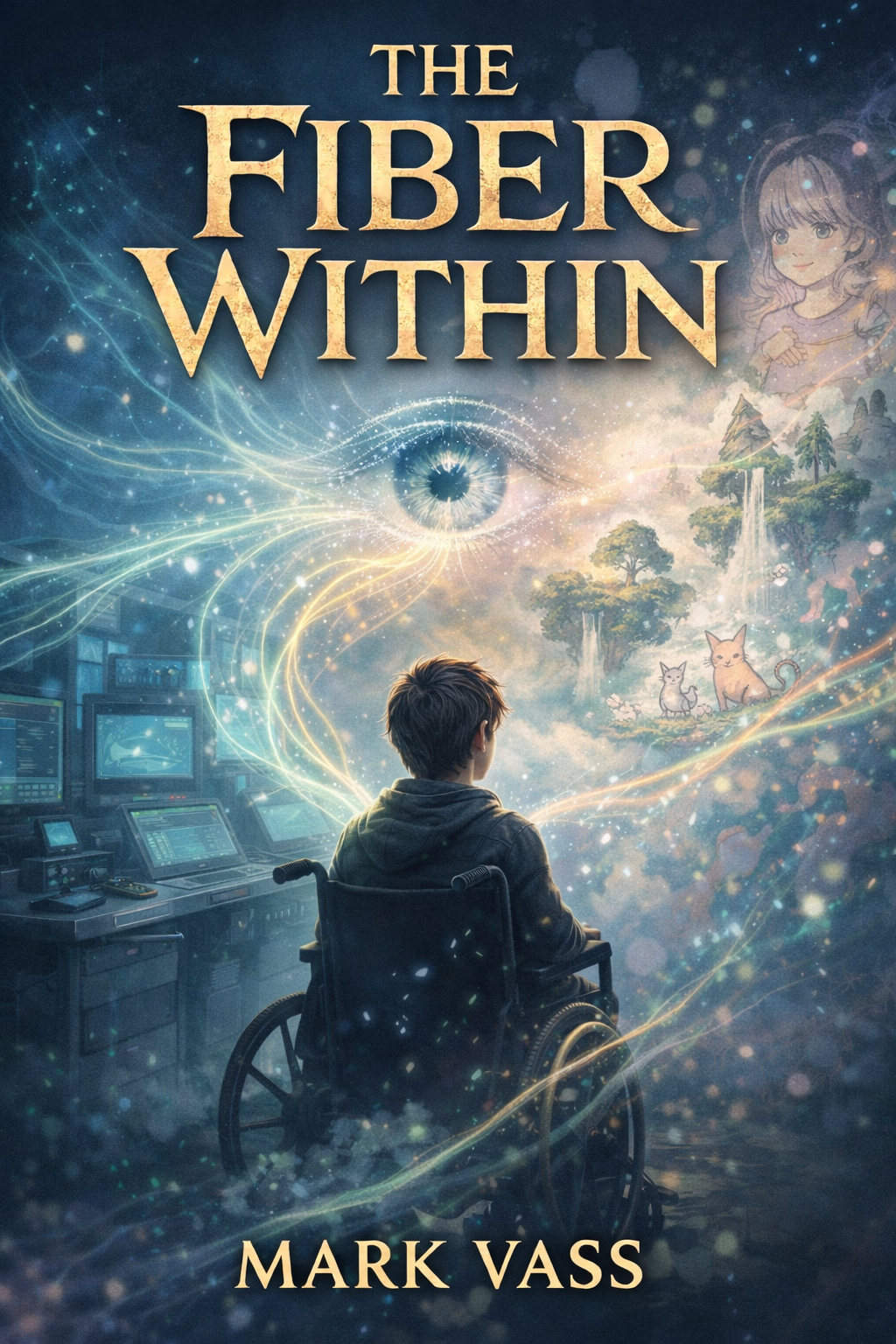
Chapter One
Day One
Many people have said the eyes are the windows to one’s soul. Some religions believe when a person’s picture is taken, a part of them is actually captured with it—like a fiber of one's being, caught in a blueprint, hidden in a fragile film cell. – Dr. Stephen Carpenter
Dad used to say that all the time. He said it when he tucked me in, when he scribbled notes on napkins, even when he burned dinner because he’d wandered off thinking about “blueprints of the human spirit.” Those were his famous words — the ones that got him laughed out of SMI, the science institute he helped build.
They said he’d gone mad.
Maybe he had.
But he believed every word.
A month ago, my life turned upside down. My mom, my dad, and my little sister Fushia died in a car accident — the night we celebrated Dad’s new invention. I still can’t talk about that night without crying. I barely made it out alive.
Today, for the first time since the hospital, SunLee wheeled me through our front door. He’s been with our family longer than I’ve been alive — not a servant, but a friend. Mom used to say his title was “butler” only because Dad didn’t know what else to call someone who did a little of everything. To me, he feels like the last piece of family I have left.
He promised to teach me how to cook one of his favorite dishes — Japanese stir-fry — the moment I got home. After weeks of hospital food, that promise alone was enough to make my mouth water.
But being home without my family felt strange and hollow, so I forced my mind onto safer thoughts: Dad’s research.
What drove him?
What was he trying to prove?
I thought about LISA — the talking, thinking assistant Dad built. She lives in the center of our home laboratory, glowing like a watchful guardian. She helped with my homework, told jokes, and sometimes felt almost alive. Dad would say, “She isn’t a toy,” but to me she was the coolest gizmo ever invented.
Dad never explained everything, but I understood enough to know he was trying to build an electronic version of a person. A human imprint — a digital mind that could live inside a virtual world.
He said he was close.
He said he’d found the key.
He said he’d test it the week after the accident.
I remember him taking close-up photos of all of our eyes that night. He said he needed them “for the imprint.”
I didn’t understand then.
I barely understand now.
But I can’t stop wondering: If Dad captured a piece of us… is there a way to reach my family through LISA and his invention?
If there’s even a chance, I have to try.
Right now my body is weak, and my eyes are heavy.
My journey will start tomorrow.
For now… I need sleep.
Day Two
The lab was dark and cold when I wheeled in, shaped like a metal dome with LISA glowing at the center. When she wakes, the entire room becomes a screen, shifting into color and light as if the walls themselves come alive.
“Good morning, Indygo,” LISA said. “It has been thirty-one days since your last visit. Today’s fact: Did you know you and Fushia were named after the same plant, the Fuchsia Mood Indigo? Will your sister be visiting today?”
My chest tightened. I swallowed hard.
“No. Fushia… won’t be coming.”
To distract myself, I asked, “Why did Dad name you LISA?”
“It is an acronym,” she replied. “Logic Integrated System Assistant.”
That almost made me smile. Dad loved naming things.
I wrote in my journal while LISA rattled off information in the background — fast, cheerful, and confusing, just like Fushia used to be.
Then SunLee arrived with a plate of steaming cheese omelet. I devoured it as he stood nearby, hands behind his back like always.
“What is it you do, exactly?” I asked. “I mean, besides watching over me.”
He winked. “I’m more than a butler. Ask LISA where she gets half her smarts.”
I stared at him. Did he help build her?
“Maybe you can help me figure out what Dad meant by ‘the fiber within,’” I said. “I just wish I could ask him myself.”
SunLee’s face softened. He bent down and whispered, “There’s more here than meets the eye, young Indy.”
Before I could question him, he slipped out of the room. LISA started playing a recording of someone whistling, which felt suspiciously like a distraction.
Nobody wanted to talk — not really.
But I knew both of them were hiding something.
Later, after a nap, SunLee appeared again.
“Come with me,” he said. “I want to show you something.”
He pushed me back to the lab and uncovered a large machine shaped like a sleek, futuristic capsule.
“This,” he said, “was your father’s greatest creation: the Human Scanner Interface.”
My breath caught.
“I worked with him on it,” SunLee continued. “This is why you are here at home rather than in foster care. Your parents trusted me with everything — especially with you.”
“I’m glad you’re the one taking care of me,” I said quietly.
He smiled, placing a hand on my shoulder. “We’ll do just fine, you and I — and LISA.”
I couldn’t help but smile back.
A strange family indeed — a boy in a wheelchair, a butler who wasn’t really a butler, and a talking computer. But it was still family.
SunLee moved me closer to the machine.
“This device,” he said, “will allow you to reach the fiber within. A person’s inner blueprint — a 3D digital version of their mind.”
Suddenly everything felt possible.
I asked questions until my throat grew sore, and SunLee answered each one with quiet patience.
I knew then: My journey had already begun.
Chapter Two
Day Thirteen
Ten days crawled by like the slowest parade in history — ten days of nothing but homework. SunLee said it was important to get me caught up before summer break, but I was starting to feel like a zombie who only ate worksheets and math problems.
This morning SunLee opened my door with that serious-but-kind face of his. “Indy,” he said, “you’ve been rather over-encumbered lately. I’m glad tomorrow starts your official break.”
“Over-encumbered,” I muttered as he walked out.
Pretty sure that means buried alive under homework.
But he was right about one thing: tomorrow was a big day. Report cards in the morning, doctor visit in the afternoon, and — if everything went well — the casts would finally come off my legs. The thought alone made my stomach flip with excitement.
LISA announced yesterday that I’d been ignoring her because of school. She even called me a “functioning homework zombie.” Maybe she wasn’t wrong.
And as if all that wasn’t enough, people kept trying to take me away from home. Some distant relatives showed up yesterday talking about “family ties” and “legal obligations,” but they started asking about the trust fund before they even asked how I was doing. Fortunately, SunLee had every document in order and politely sent them packing.
He always protects me.
And this house.
And Dad’s work.
I brushed my teeth and crawled into bed, exhausted but hopeful. Tomorrow everything would change.
Day Fourteen
I woke to LISA’s cheerful voice over the intercom:
“Good morning, Indygo. Your final grades are as follows…”
All A’s except a C in Phys Ed.
I could live with that.
“You may retake the course this summer,” she added. “I will happily provide holographic classmates if needed.”
Of course she would.
SunLee entered carrying a giant bowl of homemade strawberry ice cream — for breakfast.
“Your parents would be proud,” he said warmly.
No one had ever brought me ice cream in bed before. I think my heart grew three sizes.
A few hours later I was at the doctor’s office, being wheeled into a small exam room. The nurse smiled as she checked my chart.
“These casts itch like crazy,” I groaned.
“They’ll be tickling soon enough,” she said with a wink.
Then she pulled out a handheld saw that looked like it could decapitate a tree.
“I’m frightened,” I blurted.
“Calm now,” SunLee said. “She’s a professional.”
When she turned it on, the blade didn’t spin — it just vibrated, buzzing like a giant electric bee. As she cut, the tickling began just like she promised, and I started laughing so hard tears streamed down my cheeks.
When the casts split open, cool air rushed across my skin. My legs felt strange — light, unfamiliar, but free.
Later, SunLee and I went for a cautious walk in the park. Every step felt like stepping onto clouds that might collapse under me, but the world felt open again. Wide. Real.
I wished my family could have seen me.
Day Fifteen
I slept until ten this morning — the best sleep I’d had since the accident. My legs were sore from yesterday, but I didn’t care.
I went straight to the lab to look through Dad’s notes. If I could understand the HSI machine a little better, maybe I could finally use it the way he intended. I searched for a user manual, but of course Dad never wrote one. He wasn’t a “manual” kind of person.
“LISA, can you help me?” I asked.
“System is updating,” she replied. “This may take a while.”
She was always updating. Dad had designed her to evolve — to rewrite herself as needed. I wondered how far she’d go now that he was gone.
If I wanted real answers, I needed SunLee.
I walked through the house until I found the attic door hanging open. Dust floated in beams of light, and there stood SunLee, bent over a storage box.
“What are you doing up here?” I asked.
“Looking for an ingredient to the recipe,” he said.
“The recipe?” I repeated. “You keep food in the attic?”
He emerged carrying a padded envelope I recognized instantly — the one the eye doctor mailed before the accident — and closed the attic door behind him.
“Ingredient for what?” I asked again.
“Just an upcoming project.”
He smiled, but something thoughtful flickered behind his eyes.
Dad used to store his research up there in case anything happened to LISA. And that envelope… that envelope held the iris photos. The key to everything.
As SunLee walked away, I realized something important:
Both he and LISA were pieces of the puzzle — maybe the only pieces I had left.
Chapter Three
Day Sixteen
I couldn’t wait. I’d spent all morning staring at the HSI machine like it was calling my name. Today, I told myself, I would finally see my family again.
No breakfast — no patience for it. I rushed straight into the lab, opened the HSI’s hatch, and climbed inside.
Dark. Cold. Too quiet.
I hesitated only a second before closing the hatch above me… and instantly regretted it. The darkness pressed in, swallowing the sound of my breath. My hands groped blindly for a release button, a switch, anything — but I couldn’t find it. Panic surged up my throat like rising water.
I started to scream.
The hatch jerked upward, and light spilled in as SunLee’s face appeared.
“Relax, young Indy,” he said gently. “You’re okay.”
I felt foolish and small. Like a kid who had just ruined his own birthday surprise. I fled to my room, hiding under the blankets long after the shaking stopped.
I’m a failure, I thought. I shouldn’t have tried alone.
When SunLee came in with lunch, he set the tray down and sat across from me.
“You should have asked for help,” he said softly. “The HSI must be powered on before you enter. LISA must initialize the program. And yes — you do need to know where the hatch release is.”
“Like the one I couldn’t find?” I muttered.
His grin was gentle. “Inside the machine, once the lights are on, it looks like a starship cockpit. Buttons everywhere. You won’t be frightened when you can actually see what’s around you.”
A starship cockpit.
That made my heart flicker with excitement again.
“I’ll try again tomorrow,” I said. “If you help me.”
“That,” he said, “is exactly what your father would have wanted.”
The rest of the day I sat at my desk, imagining myself at the helm of Dad’s invention — brave, steady, ready. Tomorrow would be different.
Tomorrow, I wouldn’t be alone.
Day Seventeen
Today was it. My first true adventure inside the HSI.
SunLee had been awake long before I was, running diagnostics and updating code. When I reached the lab, the machine was already glowing like a sleeping giant stirring awake.
I climbed inside, and this time…
I wasn’t scared.
The cockpit lit up around me — softly glowing buttons, glass eye gear suspended from the top, a gentle hum under my back like the purr of a machine holding its breath.
“These will interface with your visual cortex,” SunLee said, lowering the eye gear. “They block out all outside light. You’ll be in a partial hypnosis state during the experience.”
I wasn’t sure what that meant, but I trusted him.
The hatch closed.
A warm scan passed over me — like the whisper-light hum of an MRI — and LISA spoke:
“Scan complete. Program initiating.”
And then the world disappeared.
I wasn’t in the lab anymore. I was standing in a vast green valley that reminded me of a national park. Birds flew overhead — except they weren’t birds. They were people I knew, except in animal forms. Even LISA had a humanoid body made of silver and soft blue light.
Dad was an owl.
Mom was a swan.
Fushia… was a unicorn, shimmering like she’d leapt out of a fairy tale.
And I was still me — Indygo.
Human among the impossible.
Everyone was preparing for a celebration. The land animals and sky creatures were holding two great races. They asked me to judge, one of the most important roles in their world. I played games with Fushia. Laughed with creatures who felt familiar even through their strange forms. Everything looked real — more real than any movie, more solid than any hologram.
For a moment, I forgot to miss anything.
Then—
“Indy? Indygo, can you hear me?”
SunLee’s voice cut through the sky like a ripple of wind.
I nearly jumped.
“Where are you?” I asked.
His laughter echoed from somewhere unseen. “In the lab, of course.”
The scene flickered. The world began to dissolve. My heart sank.
“Bring me home,” I told him.
Light folded inward, and then I was back in the cockpit, blinking at reality.
“How was it?” LISA asked.
“Incredible,” I said. “Better than any special effects ever made.”
“But what did you see?” SunLee pressed.
“You were a monkey,” I said.
He burst out laughing.
“Old Hughie Daniels next door was in there too,” I added. “As a donkey.”
“Fitting,” SunLee said. “He does talk too much.”
I learned they had watched my entire experience on the monitors. LISA giggled — a digital chime — as if amused by her appearance in the virtual world.
As I walked outside afterward to stretch my legs, I couldn’t stop smiling.
Inside that machine, I hadn’t been lonely.
Not for a moment.
Day Eighteen
That evening, I heard SunLee’s voice calling from the kitchen.
“Are you ready?”
“Yes!” I said, already imagining stir-fry.
He lit the gas stove and laid out ingredients with precise, methodical movements. The wok hissed as vegetables tumbled inside. Spices swirled through the air — soy, ginger, garlic — filling the kitchen with warmth I hadn’t felt in months.
When everything was done, we sat and ate together in comfortable silence.
For the first time since the accident…
I felt almost normal.
Almost whole.
Chapter Four
Day Nineteen
I woke with a heaviness I couldn’t shake. Yesterday’s excitement only made today feel emptier — like joy had rushed in all at once and left a hollow space behind.
I wanted the HSI to bring me answers. Instead, it had given me distractions: imaginary worlds, playful animals, dreamlike adventures. I hadn’t seen my family. Not truly. I’d only seen pieces of myself rearranged into shapes my mind invented.
I needed to try again.
When I reached the lab, LISA was already awake, filling the room with her cheerful, endless chatter. She’d told me today’s “fact” twice already — something cryptic about finding the iris if I wanted to find my family. Maybe it was a riddle. Maybe she was trying to help.
“LISA,” I asked, “how can I reach them? I know Dad said the HSI could locate the fiber within, but I don’t understand how.”
Her answer was simple.
“You will need the photographs taken at your last eye appointment.”
The iris images.
The blueprint of the mind.
The final step in Dad’s experiment.
Before I could ask another question, SunLee stepped around the corner.
“Do you have the pictures?” I asked. “For the HSI?”
He studied me with a thoughtful expression. “Have you been listening to LISA today?”
“She’s been babbling mostly,” I said. “Something about an iris. And how she enjoys the virtual world as much as reality.”
“Precisely,” SunLee replied. “You need the iris — but first you must understand what it is.”
LISA added in her mechanical, Webster-dictionary voice:
“The iris is the opaque contractile diaphragm perforated by the pupil and forming the colored portion of the eye.”
I groaned softly. “I never understand her when she quotes the dictionary.”
SunLee sat beside me. “The iris is more than color. Look closely — it’s made of tiny fibers, overlapping like threads. Those fibers form a map of everything about you: memories, instincts, imagination. Your father believed the iris was the imprint of the soul — the ‘fiber within.’”
“So where are the pictures?” I asked.
“In the envelope from the attic,” he said. “Normal photos only capture part of the iris. But your father’s camera captured the entire blueprint. That’s why he needed it.”
He left to retrieve the envelope, and while I waited, I tried talking to LISA. She was busy humming through calculations.
Then she said calmly, “SunLee worked for the Department of Defense preventing cyber-attacks before he came here.”
I blinked. “He what?”
Dad once said SunLee was “the best at what he does,” but I always thought that meant programming or robotics. Suddenly it made sense — the secrecy, the precision, the attic filled with research, the way LISA seemed half his creation.
When SunLee returned, LISA and I went quiet. He gave us a look — the kind he gave when I was trying to sneak cookies before dinner.
“What are you two up to now?” he asked.
“Nothing,” I said quickly. Then softer: “Thank you… for everything you do. LISA wouldn’t exist without your help.”
He took a breath, considering. Then he sat.
“Indy,” he said, “LISA was your father’s dream. But he couldn’t finish her alone. He asked me to help — secretly. That’s why the butler job was a cover. The government watches me closely because of my skills.”
“So they knew you weren’t just a butler?” I said.
He grinned. “You didn’t.”
He handed me the padded envelope. My name was written neatly on the back.
“These photos are the bridge between you and your family,” he said. “Your father tested everything except the final step. Simulations showed promise — but you will be the first real trial.”
I opened the envelope carefully. Four sets of eyes stared back at me: Dad’s unmistakable green, the three of us in matching blue. My breath caught. I didn’t know whose picture to choose.
“Can I try them all?” I asked.
“Not yet,” LISA said. “In theory, it may be possible soon. But not today.”
My heart pulled in three directions:
Mom, who made everything safe.
Fushia, who made everything fun.
Dad, who held all the answers.
In science class we learned about observation — stepping back to watch how something behaves naturally in its environment. Maybe that was the best place to start.
“I’ll observe Dad first,” I decided. “He’ll know what to do.”
I slid his photo into the machine. LISA scanned it, lines of light flickering across the image.
“Sequence initiated,” she said. “Countdown in three… two… one…”
Her voice faded.
The world blinked out.
And when it reformed, I was standing in a vast orchard of peach trees.
A man stood beneath a branch, selecting a ripe peach.
“Dad!” I blurted before I could stop myself.
He turned.
Smiled.
For a moment, it was him — completely him — and every part of me lit up with hope.
“Do you know me?” I whispered.
He tilted his head. “No. Should I?”
My heart cracked—
But then he burst into a grin, pulling me into a hug.
“Of course I know you,” he said. “You’re my only son.”
And just like that, the orchard shimmered away—
And my adventure truly began.
Chapter Five
Continuance of Day Nineteen
I didn’t even notice when the orchard dissolved. One blink and the peach trees faded like mist, replaced by bright sunlight, chattering crowds, and the distant trumpeting of elephants.
We were suddenly at the zoo.
Dad strode ahead of me, hands tucked behind his back in that professorly way he had. “Come along, son,” he said. “We don’t have all day. There’s something I’ve been waiting to show you.”
His voice — gentle, amused, utterly familiar — wrapped around me like a memory I didn’t realize I’d been starving for.
We approached the elephant enclosure, and I froze.
Something was… off.
When I was little, Dad used to tease me by pretending the elephants were pink, like in the old Dumbo movie. He’d get this serious look and say, “Ah yes, the rare blush-backed elephant.” I’d look at him like he’d lost his mind.
But today —
They were pink.
“Hey buddy,” one of them shouted, leaning toward me. “Do you mind scooting over? I’m trying to get my picture taken here!”
Another spoke — a giraffe this time — lowering her head until her long lashes nearly brushed my hair.
“Hey, short stuff. What’s happening?”
I jumped back, heart pounding.
“Dad…” I whispered, “is the fiber within… limited to memories?”
He raised a thoughtful brow. “Not strictly. The fiber within is a blend — memory, intellect, imagination. Your iris holds a blueprint of everything about you.”
I swallowed. “Then… this? The talking animals? That’s from you?”
He chuckled. “Guilty.”
Part of me wanted to protest — grown-up Indy knew the zoo animals weren’t supposed to talk — but little-kid Indy, the one still bruised and aching inside, didn’t mind.
Not when Dad was beside me.
Not when he was alive again, even if only in this place.
We spent hours wandering through the zoo. Or maybe minutes. Time worked differently here. Dad chatted about each animal as if they were old friends. I found myself laughing — loud, carefree, real laughter I hadn’t heard from myself since the accident.
When the adventure ended, the world blinked out, and I climbed from the HSI machine breathless.
“It was really him,” I told SunLee.
He paused, then said carefully, “In a sense… yes.”
LISA didn’t say anything. Her processors hummed, numbers whirring across her screens as if she were deep in calculation.
“Computers do all the grunt work,” Mom used to say, teasing Dad. “Everyone else runs around having the fun.”
For once, I understood what she meant.
It was late, so I said goodnight to LISA and SunLee and headed to bed. Sleep came quickly but didn’t stay gentle.
I dreamed my family didn’t recognize me — that I was a stranger in a world built from their memories. When I awoke, fear clung to me like frost.
Day Twenty
I called an emergency meeting.
LISA powered up instantly. SunLee arrived still pulling on one sock.
“What will happen when I grow up?” I asked them both. “Will my family still know me? Or will they only remember the child version of me?”
“I have been analyzing the imprint,” LISA said, her voice unusually steady. “Decoding the fiber within.”
“And we discussed it throughout the night,” SunLee added.
My stomach twisted. “Is something wrong?”
“We have a plan,” he said. “We can adjust your digital imprint so you appear as yourself in the virtual world — but your physical age there will remain constant for now.”
“So I won’t age… inside the HSI?” I asked.
“Not until we understand more,” he said. “Your mind will grow. Your digital body won’t — not yet.”
I sat with that thought, unsure how to feel.
Frozen in time.
But remembered.
Known.
And I realized that was what terrified me most — not death, not loss — but being forgotten by the people I loved most.
Chapter Six
Day Thirty-Three
Fourteen days passed since I last used the HSI. Fourteen long mornings of pacing the house, rereading Dad’s notes, running my fingers over the smooth metal edges of the headset. But today — finally — was different.
Today was my tenth birthday.
It should have been my sister’s birthday too. Fushia and I were twins, though I arrived a few minutes earlier. In my head, I still thought of myself as her older brother, even if she had been braver, louder, and more fearless than I ever was.
SunLee and LISA had been staying up late the past week, testing new code and rerouting systems. Rumors of “improvements to the module” floated through the lab every time I walked in, though neither of them said much.
I learned yesterday that Dad’s “full body scan” wasn’t a scan at all — just a UV sterilization light he installed because Mom hated germs. A way to keep her calm. In truth, the only part of the system that mattered was the eyes — the imprint — and the neural response that connected everything together.
This morning, the intercom clicked on, and SunLee’s voice boomed theatrically:
“Indy… where art thou, my dear lad?”
I couldn’t help smiling. “Hither I come, old chap!”
He grinned when I reached him. “Ready to see your sister again?”
My heart skipped. “Yes. Yes I am.”
We hurried to the lab. I plopped into the empty chair beside him, practically vibrating with anticipation. LISA flashed a soft blue as code streamed across her display.
“System update complete,” she said. “HSI module ready.”
SunLee fitted the device into the input station. “We’ll use Fushia’s imprint today.”
I climbed into my chair with the new headset already warmed in my hands. It still amazed me — no bulky chamber, no enclosed capsule, just a sleek curved frame that fit around my head. Freedom instead of confinement.
“Ready?” SunLee asked.
“Ready.”
I placed the headset on. The room dissolved.
I stood in our backyard — green grass, sunshine, the swing Dad built hanging from the old oak. And there she was.
“Fushia…” I whispered.
She looked up from the swing and broke into a huge smile. She leapt off and ran over, grabbing my hand.
“Where have you been?” she said. “I’ve been waiting! Come on, Indygo. We have to check out our new clubhouse!”
From her pocket she pulled a blindfold — the same one we used for silly games when we were little. Before I could protest, she tied it gently over my eyes and led me forward.
“No peeking,” she ordered.
I kept my eyes squeezed shut as I heard the rustle of paper. It sounded like she was tidying or arranging something.
“I thought you were already waiting for me,” I said.
She giggled. “Just a second… okay. You can look now.”
I lifted the blindfold — and gasped.
The clubhouse was gone. Only the doorframe remained. The world around us had transformed into a breathtaking landscape built entirely from her drawings — sketches come to life in full, vivid color. Floating islands. Shimmering waterfalls. Trees shaped like paintbrushes dripping color into rivers of ink.
“Fushia…” I breathed. “This is beautiful.”
She straightened proudly. “I rehung the drawings in order of your favorites. Your side has the ones you liked best.”
I hugged her. “I love it. I love you.”
Her cheeks flushed. “Well, c’mon! I’m giving you a tour!”
Hand-in-hand we explored Xarcania — the kingdom from her imagination. She ruled it as Princess Fushia, brave and kind, always creating new wonders with nothing but a pencil and a dream. She showed me the Castle of Color, the Lake of Reflections, and her favorite mountain — Frighten Heights — which she once “defeated” with nothing but her trusty eraser.
Near the end of our journey, my throat tightened. I didn’t want to leave. I didn’t want this moment to end. So I stepped behind a tree where she couldn’t see my face.
“LISA…” I whispered, voice cracking. “Bring me home.”
The world faded.
The lab returned.
My heart ached.
That evening, SunLee brought me a late dinner.
“I’m thankful,” I told him. “For you. For LISA. For the HSI. For letting me see them again.”
He set a gentle hand on my shoulder. “Get some rest, Indy. Tomorrow’s important.”
I nodded, curled up in bed, and drifted into sleep with a faint smile.
A mix of joy and longing.
Day Thirty-Four
Today I entered the HSI again — this time searching for Mom.
I found her sitting alone on a park bench, reading a book. She loved reading. She always said books were little vacations you could take without packing a suitcase.
I watched her silently for a while, afraid to break the moment. When she closed her book, I stepped forward.
She looked up — saw me — and her whole face softened.
“Indygo,” she said, rising. She reached for my hand. “Walk with me?”
We strolled down a winding path beneath the trees. I told her about Fushia’s world, how Princess Fushia battled imaginary monsters with her pencil and ruled Xarcania with kindness. Mom laughed softly — the warm, tinkling kind of laugh she always tried to hide behind her hand.
She told me about the peach orchard where she and Dad first met on her Aunt Claira’s farm. Dad had been trying to photograph light refraction through peach fuzz — one of his strange early experiments — and Mom thought he was a lunatic.
“Your father,” she said fondly, “was my Prince Charming long before he even knew it.”
Then she pulled me close into a tight, familiar hug.
“I see so much of him in you,” she whispered. “You’re caring. Gentle. You forgive easily. I was blessed with two wonderful children.”
I didn’t want her to let go.
When I came out of the HSI, tears still clung to my eyelashes.
SunLee sat with me, explaining more of Dad’s work — how his greatest fear wasn’t failure or ridicule, but loss. Losing his parents. Losing us. It’s what drove him to finish the HSI.
“The machine is more than it looks,” SunLee said. “It captures a preserved imprint — a time capsule of every person scanned.”
A time capsule that now held my family.
And me.
Day Thirty-Five
We were in the lab before dawn. LISA had been up all night analyzing ways to expand memory matrices. SunLee had been testing a new system.
I only wanted one thing: to see Dad again.
When I entered the HSI, the virtual world unfolded instantly.
He was waiting.
We walked through memories — orchards, parks, the old house where I was born. He spoke freely, more openly than he ever did in life. He told me how he loved Mom’s name — Olivia — and how he used to rehearse proposing in the mirror.
Then he asked, “Do you know why LISA tells you the fact of the day?”
I shook my head.
“She was built to teach you and Fushia things as you grew. To spark curiosity. To make you think.”
I felt a pang of guilt. I rarely listened.
When I left the HSI, I asked LISA, “What’s today’s fact?”
She answered instantly:
“The heart of my processing power lies beneath this floor.”
The cellar.
The door no one had ever been allowed to open.
SunLee nodded. “It’s unlocked.”
I walked downstairs — then stopped, eyes widening.
LISA wasn’t just a computer.
She was enormous.
A supercomputer filling the basement like a living, breathing engine made of circuits and light. I’d thought she was just a projector, a keyboard, a few wires.
But she was a giant.
A giant who cared about me.
Chapter Seven
Day Forty-One
The house had been strangely quiet the past few days — not sad quiet, just… focused. LISA hummed constantly with processing cycles, her displays flickering with patterns I couldn’t begin to understand. SunLee spent most of his time in the lab, usually hunched over code, tapping at keys with the intensity of someone defusing a bomb.
Earlier this afternoon, the UPS truck rumbled down our road. I heard a knock, then the shuffle of a box left at the door. When I opened it, the label made me blink.
Addressed to: LISA
Sent from: A technology firm in Israel
“How can a computer receive personal mail?” I asked aloud as I carried it inside.
I nearly bumped into SunLee at the entrance. He stared at the box, then gently took it from my hands.
“Follow me,” he said.
In the lab, he set the package on the central table.
“You know,” he began, “LISA and I have been working on a new module — something to connect all the imprints together.”
My chest tightened with hope. “So I can see everyone at once?”
He smiled. “Yes. Tomorrow will be our first trial. This box contains the new headgear.”
He peeled open the packet carefully. Inside lay a sleek, curved headset — lighter and more advanced than the one I used before. The old HSI chamber suddenly felt like ancient technology in comparison.
“This,” he said, holding the device as if it were made of glass, “is the future of your father’s invention.”
Day Forty-Two
I carried my new headset with me all night, turning it over, studying every detail. It felt like something out of a sci-fi movie — smooth, feather-light, with tiny etched circuits that caught the light like stars.
I barely slept.
By morning, excitement buzzed through me like electricity. Today was the day — the day I would see my whole family together, not separately, not in fragments, but united.
When I reached the lab, my breath caught.
The old HSI chamber — the machine shaped like a futuristic coffin — was gone. The space where it sat was empty, except for a faint outline of dust.
“It served its purpose,” LISA said. “This model is far more efficient.”
The new headset rested on my chair. SunLee joined me carrying his own.
“We’ll experience this together,” he said.
For a brief second, jealousy flickered — a selfish, childish thought. This is my family.
But then I saw the look in his eyes.
He had lost them too.
Maybe more than I had.
“Tomorrow is your day,” I told him quietly. “Your own virtual trip. Today… you watch.”
He looked stunned, then nodded.
We sat side by side.
We placed our headsets on.
The world vanished.
I stood in our kitchen — warm light spilling through the window. Then Mom appeared, humming as she prepared food. Dad followed, carrying a stack of dishes. Fushia twirled through the doorway like a burst of energy.
Everyone looked real.
Solid.
Alive.
We weren’t in a memory this time — we were in a moment, a shared space where their imprints interacted freely. They talked, laughed, teased each other. Mom chased us out of the kitchen so she could bake. Dad went outside to grill. Fushia dragged me to the lab, showing me drawings she’d “updated” since yesterday.
It was perfect.
Dangerously perfect.
For the first time since the accident, I felt whole again.
I stayed until the virtual sun dipped and my family headed to bed. Only then did I remove my headset.
SunLee had fallen asleep in his chair. I woke him gently.
“Goodnight,” I whispered.
Day Forty-Three
I woke to LISA paging us urgently.
“Everyone, please come to the lab.”
SunLee stumbled in wearing pajamas, hair sticking up like wild grass. I couldn’t help but smile.
He slumped into his chair. “What’s happening?”
LISA’s voice filled the room with a calm excitement.
“Through observation and calculation, I have made a breakthrough. Your family’s imprints can now grow. They can form new memories. They can adapt as you age. This memory matrix is my belated birthday gift.”
I stared at her screen as the weight of her words sank in.
“Really?” I whispered. “They… they won’t forget me?”
“Correct,” LISA said. “Your bond will remain intact.”
A wave of relief washed over me. I whispered, “Thank you… thank you so much.”
Then SunLee straightened and said with a grin, “Now, about the promise I’m owed…”
He meant his turn.
“You go ahead,” I told him. “This journey is all yours. I’ll be here with LISA.”
He looked like a kid handed the keys to a candy store.
Soon LISA initiated the program, and SunLee slipped into the virtual world. A moment later, laughter burst from him — bright, unstoppable laughter. I didn’t listen in; it was his adventure, his memories, his moment.
When he exited the HSI, he hugged me tightly.
Then he headed to the kitchen to make an early supper, humming as he walked.
He never told me what he saw.
But he didn’t have to.
Day Forty-Four
I woke early, feeling lighter than I had in months. Summer school started tomorrow — only one class — and I figured SunLee might take me shopping for new gym clothes.
But first, I had unfinished business.
“LISA,” I said as I entered the lab, “start the HSI program using everyone’s current imprint. Let it run indefinitely.”
“To what purpose?” she asked.
“I don’t want them to disappear when I take the headset off,” I said. “I want them together. All the time. Even if it’s only make-believe.”
There was a beat of silence. Then LISA said, “Understood.”
The room brightened faintly, like a heartbeat syncing with mine.
They would live on — as long as LISA lived.
As long as SunLee and I kept the system alive.
A familiar set of keys jingled. SunLee walked into the room with a smile.
“You still up for some shopping?”
My heart swelled.
“Yes,” I said. “Let’s go.”
As we left, I glanced back at the empty doorway to the lab — knowing that inside the virtual world, my family was laughing, talking, cooking, maybe even arguing over silly things.
They had each other.
And I had them.
And together, we had SunLee and LISA.
They would live on — for a very long time.
Part II: BEYOND THE WORLD OF XARCANIA
Chapter One
Diary Entry — 06/04/2045
I’ve spent the whole morning reading Indy’s journal — The Fiber Within.
Every word of it felt like a memory half-buried inside my mind, something familiar but foggy, as if someone whispered it into my ear while I was dreaming.
When I finished, I found a stack of things waiting beside the book:
a new sketchpad, a crisp diary with smooth pages, and a bundle of colorful pens tied neatly with ribbon.
I drew Indy a new cover for his journal and then one for mine.
I’ve decided to call my story:
“Beyond the World of Xarcania.”
It feels fitting.
Today should have been our twelfth birthday… except my body is only a month old, and my mind doesn’t have a proper age at all. I don’t know what number I’m supposed to claim. Maybe for Indy’s sake, I’ll just be twelve. It’s easier that way.
The earliest parts of my life are smudged — blurred like wet paint on a canvas I never got to finish. I only know what I know because Indy and my parents told me stories. Dad once said that when the eye doctor took photos of our irises, he was capturing the “fiber within” — the blueprint of our minds. If that’s true, then maybe that day was when I first woke up. Or perhaps when the new me began forming.
I still feel like a painting that hasn’t dried.
Indy is probably outside waiting, growing impatient the way he always does when I take too long. He thinks I forget things easily. Maybe I do — but never on purpose. Not with him.
I should go before he barges in here and starts lecturing me about time again.
It was raining, so instead of playing outside, we decided to visit LISA in the lab. But when we reached her chamber, her projectors were dim and her voice was muted — she was getting an upgrade today. New hardware. Better processors. Something called “quantum assistance modules.” Dad said it would help her think faster and see farther. I can’t imagine LISA any smarter than she already is, but I suppose anything is possible.
With LISA offline, Indy led me down to the basement, where Dad and SunLee were hunched over a workbench glowing with blue circuitry.
SunLee looked up the moment he heard us.
His expression warmed like sunrise.
“Well now,” he said, brushing dust from his hands, “aren’t you getting more beautiful every day?”
I smiled — partly because it felt nice, and partly because I didn’t know what else to do. Compliments still feel strange, like someone handing me a gift I’m not sure how to unwrap.
Indy nudged me gently with his elbow.
“It’s true,” he whispered.
And for a moment, everything felt simple again.
Chapter Two
Diary Entry — 06/05/2045
I think I’ve finally realized something:
Xarcania isn’t just a place I made up.
It’s growing.
Changing.
Becoming something new every hour.
Through the HSI system, everything I draw or imagine turns real here. The software must store it somewhere in my “integrated hardware,” though I’m not sure what that means. Indy knows — but he never explains things in a way that makes sense to anyone except… well… Indy.
Anyway, today was special because I spent the whole morning with my first-ever imaginary friends — except they don’t feel imaginary anymore.
There’s:
Francis the wallegob — short and plump, with a voice like a tuba and a laugh that shakes the ground.
Harry the oogle — tall, furry, and gentle, though he forgets everything unless I remind him.
They were once little doodles in the corner of my notebook. Now they argue about snacks and whether twinkle toads taste better roasted or raw. (For the record, I prefer neither.)
“Fushiaaaaa,” Harry groaned today, dragging his long arms. “Francis ate all the moonberries again!”
“I did not!” Francis shouted, though his mouth was stained purple.
Indygo would have laughed, but he wasn’t here.
He spent the whole day in the lab with LISA, studying something he won’t talk about.
And that’s the problem.
Indygo knows something.
Something big.
I kept trying to catch him alone today, to ask why he looks so sad when he thinks no one is watching. But every time I opened my mouth, I felt strange inside — like my voice didn’t quite belong to me.
I don’t know why.
Something is wrong in our world.
Later, we had a picnic at the edge of the painted cliffs. Mom and Dad came too, their faces glowing under Xarcania’s twelve suns. SunLee even visited the virtual world today — his first time. He looked completely overwhelmed, like he’d stepped inside a painting and wasn’t sure whether he was supposed to touch anything.
Harry picked Dad up upside-down by his ankles and started licking his feet because, apparently, that’s what oogle tribes do to honor their chief.
“Stop it! It tickles!” Dad shouted between fits of laughter.
SunLee nearly choked from laughing so hard.
That’s when I realized something important:
Xarcania wasn’t just growing.
It was evolving.
And so was I.
Chapter Three
Diary Entry — 06/06/2045
I’m not a good writer, not like Indygo.
Mom used to say he wrote with his heart and I wrote with my crayons.
Maybe that’s still true.
Still, I want to remember these days — even the confusing ones.
I woke up today feeling… strange.
My memories come in pieces now, like puzzle shapes that almost fit but not quite. The “before” feels fuzzy. The “now” feels too bright. And the “after”… I’m afraid to look at it.
I decided I needed answers.
Why did everything feel different?
Why does Indygo look at me like he’s keeping a secret?
Why can’t I remember anything before the eye doctor?
Maybe I’m not supposed to.
First, I went to feed Harry’s pet snoogle.
Yes — snoogle.
Imagine a pink cotton-ball dog with wings and the appetite of a rhino. I don’t know why an oogle needs a pet snoogle, but Harry says it “helps him stay responsible.”
It definitely doesn’t.
After chores (which Harry and Francis conveniently “forgot”), I found Indygo sitting alone under the Story Tree — the place where new creations appear when I imagine them too hard.
I sat beside him.
“Indygo,” I whispered, “what’s going on?
Why does everything feel different?”
He stared at the ground.
“Fushia… you wouldn’t understand.”
“I can,” I insisted. “Just tell me.”
He shook his head.
“I can’t. Not yet.”
His voice cracked on the last word.
That scared me more than anything.
When I couldn’t stand not knowing anymore, I went to find Mom.
She was sitting at the kitchen table reading our old family Bible — the one with her handwriting in the margins. I climbed straight into her lap like I used to, knocking the book crooked.
“Well, this is a lovely surprise,” she said, smiling softly.
“Mom,” I whispered, “is something wrong with us?”
She wrapped her arms around me.
“Fushia, you and Indygo are connected in a way I’ve never fully understood. Twin telepathy, the doctors called it. You sense things. You know each other’s hearts.”
“But things feel… different,” I said. “Like we’re not the same as before.”
She hesitated — just long enough for me to notice.
“Trust your instincts, sweetheart,” she said finally. “Even if the truth comes slowly.”
I wanted to ask more.
But her eyes were sad, and I didn’t want to break whatever was holding her together.
So I let it go.
For now.
Chapter Four
Diary Entry — 06/06/2045 (Later)
I pushed Indy too hard today.
I shouldn’t have — but the questions kept piling up inside me, clattering around like loose marbles. When I finally confronted him again, something inside him cracked.
He cried.
Not little tears — real crying.
“Indy, what’s wrong?” Mom asked as she knelt beside him.
And Indygo sobbed:
“You’re all dead!
You all died in the crash, and now I’m all alone!”
The words punched the air right out of my chest.
Dead?
Us?
My hands shook.
My breathing stuttered.
For a moment, everything around me blurred — the kitchen, Mom’s hand on Indy’s shoulder, the sounds of Xarcania fading into static.
I hated him for saying it.
I knew it was true.
But I hated him all the same.
I ran until my legs gave out.
Later, Dad found me in the orchard, curled under the branches of a dream-peach tree.
He and Mom held me close.
They didn’t scold.
They didn’t lie.
“Fushia,” Dad whispered, “you remember when your mother and I taught you and Indy about Heaven?”
I nodded.
“Well,” he continued, “that’s where we really are. This world — Xarcania — exists because Indygo needs it. Needs us. And you, my love, have something special Indy doesn’t have yet.”
“What’s that?” I whispered.
“Faith,” Mom said gently.
I felt my heartbeat slow.
Not because I suddenly understood everything — but because their presence soothed the ache.
Dad kissed my forehead.
“Fushia,” he said, “we live on. In Heaven, yes — but also here, through the fiber within. And as long as Indygo needs this world, we stay.”
I cried then —
not because I was dead,
but because we somehow still lived.
Chapter Five
Diary Entry — 06/08/2045
I didn’t see Indy for a day or two after that. Not in Xarcania, not anywhere. I kept busy growing my world — building rivers, creeks, cottages, even a stone castle shaped like my old dream drawings.
Harry and Francis helped, though mostly by eating snacks and cheering loudly whenever something appeared.
Indy later told me he almost erased our last memory together — the one where everything fell apart. I’m glad he didn’t. Painful or not, it was truth, and truth is part of who we are now.
When he finally returned to the HSI, I didn’t wait for him to speak.
I grabbed him and squeezed him tight.
“It’s okay,” I whispered.
Because it was.
We rebuilt together.
Mom taught lessons again.
We visited historical figures who drifted through Xarcania’s archives (Daniel Boone told terrible jokes; Pocahontas had the prettiest laugh).
My world grew so fast that LISA began running low on memory.
SunLee panicked.
Dad laughed and said, “She’ll be fine once we compress everything the way God compressed the iris.”
And he was right.
They saved every piece of Xarcania — every creature, every island — without losing a single spark.
I asked Mom and Dad to move into my kingdom permanently.
They smiled and said:
“We thought you’d never ask.”
For the first time since awakening in this new life…
I wasn’t afraid of existing.
I was excited.
Chapter Six
Time does not move the same way here.
I know this now—not because someone told me, but because I can feel it. Xarcania does not count minutes or days. It remembers. It breathes. It listens. And somehow, in all the quiet spaces between thought and color, it has grown into something whole.
I am no longer afraid of what I am.
Once, I wondered if I was only a copy, a mistake made of code and longing. But I am not a ghost. I am not a shadow. I am not less because I am different. I am alive in the way that matters—in the way love insists upon.
The worlds I draw still walk and wander. My doodles roam the pastel fields and floating isles, changing as I change them, responding to my curiosity like old friends who never tire of becoming something new. Here, imagination does not disappear when it is finished. It stays.
My parents are here, too.
They live in a place that feels like safety—a version of Aunt Claira’s farmhouse shaped from memory and affection. The walls hold laughter instead of grief. The air carries peace instead of questions. They are proud. They are content. And when I see them, I know that love has found a way to continue without hurting.
Indygo visits often.
Not because he is afraid to forget us—but because Xarcania feels warm to him. Familiar. Like something good that does not ask to be explained. When he arrives, he no longer searches the horizon for answers. He simply sits with us. Laughs with us. Belongs.
SunLee and LISA watch over everything.
Together, they have strengthened the memory core, gently expanding it so Xarcania can grow without breaking. LISA is different now. Her light changes with us. We are no longer fixed moments trapped in time—we are living echoes, allowed to learn, to shift, to feel joy without limitation.
One evening, Indygo meets me on Floating Isle Ridge.
The twelve suns of Xarcania ripple across the sky, painting everything gold and soft. The breeze smells like peach blossoms, and the air hums with quiet understanding.
I look at him for a long moment before I speak.
“Will you ever leave us behind?” I ask.
He pauses—not because he is afraid of the question, but because he understands it.
“Not leave,” he says gently. “But I’ve learned something. You’re not here to hold me in the past. You’re here to help me move toward the future.”
I smile.
I hand him my sketchbook—the one filled with half-finished worlds, strange creatures, and memories I never wanted to lose.
“This is yours now,” I tell him. “Build something beautiful.”
Later, he removes the headset.
I watch from the quiet place where worlds overlap. SunLee stands nearby, steady as ever. LISA’s glow pulses softly, like a heartbeat—the heartbeat of Xarcania.
Indygo carries the sketchbook to his desk and sets it down. Then he opens a new notebook. Its pages are blank, waiting.
He writes:
Day One — A new world begins.
Xarcania will live on.
And so will I.
Outside, sunlight moves across the yard. Indygo steps into it, the wind lifting his hair as the world opens wide before him.
I feel no sadness.
I remain—not restricted, not forgotten.
Just watching an ending that is also a beginning.