The Doll and the Dollmaker
Written by Mark Vass
In the summer of 1940, the Germans invaded the British island of Jersey.
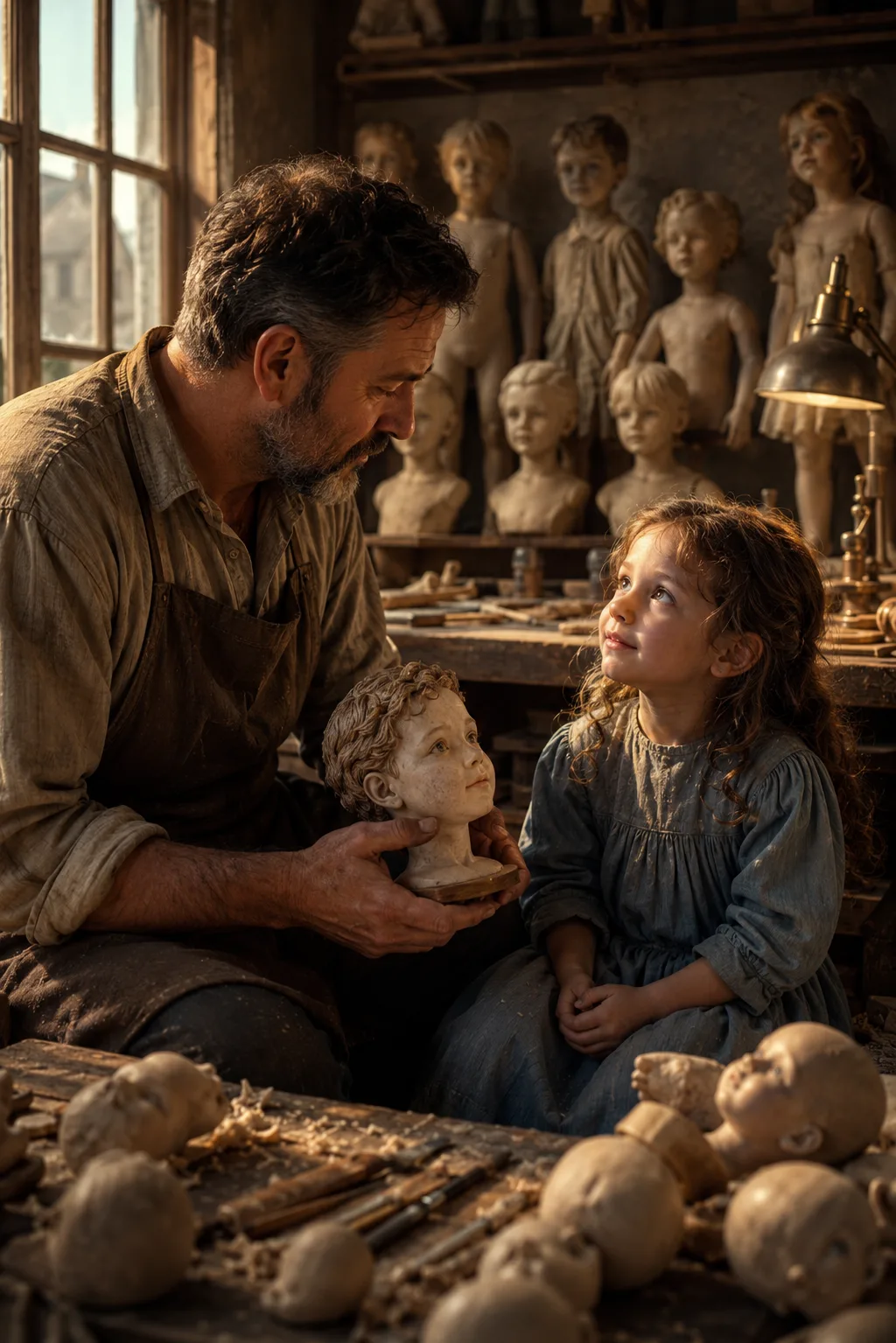
I was a dollmaker by trade, and my wife, Diane, was a third-generation seamstress. We had lived our entire lives on the island. When Nazi sympathizers smashed the windows of our little shop, mistaking us for Jews, I held Diane as glass rained onto the floor around us.
"Easy now, my darling," I whispered. "They're only windows. I can replace windows."
Though neither of us slept much that night, exhaustion finally carried us away.
Some hours later, Diane gently shook my shoulder.
"Frank," she whispered. "There's a commotion downstairs."
We listened. A floorboard creaked. Then another.
I lit a lamp, and together we descended the stairs.
The workshop was in disarray. Several of my life-sized dolls had been knocked from their stands. A boy with brown hair lay on his side near the wall. Another had lost an arm. Splintered wood, broken shelving, and torn cloth littered the floor.
"Oh, Frank..." Diane said softly. "I'm so sorry."
I knelt among the wreckage.
Then something moved.
At first I thought it was a trick of the lamplight. Beneath a fold of faded blue fabric, a small hand shifted. Slowly, the hand emerged.
A child lifted her head.
"Hello," she said, her voice small.
Diane gripped my arm.
The girl’s face broke into a familiar smile. One tooth was missing.
I knew that smile.
Several weeks earlier, a Jewish couple had brought their daughter into the shop. The little girl had spent nearly an hour talking while I worked. She had introduced herself as Samantha and smiled often enough that her missing tooth had become impossible to forget.
Now that same smile looked back at me, frightened but alive.
"Are you Samantha?" I asked gently.
She nodded.
Only much later did we learn the truth: during the chaos of that night, Samantha’s mother had hidden her among my dolls—hoping we might find her and keep her safe when the authorities came for their family. She left her own daughter behind and took a doll in her place.
Samantha remained.
Her parents disappeared into the war.
The years that followed were difficult ones. The occupation tightened its grip on Jersey. Rumors spread. Families vanished. One morning the baker’s shop never opened. A month later, a neighbor simply failed to return home. Fear became as ordinary as bread.
Yet inside our little shop, Samantha remained. She laughed. She asked questions. She followed Diane from room to room.
One evening, while Diane sat sewing by lamplight, Samantha looked up from the floor.
"Do you think my mother is still looking for me?"
Diane lowered her needle and drew the girl into her arms.
"I think," she said softly, "that a mother’s love travels farther than we can see."
Samantha seemed satisfied by that answer.
As the years passed, we gradually stopped thinking of her as a child we had found. She became our daughter.
Then the war ended.
One autumn afternoon, a stranger entered the shop. He appeared older than his years. His eyes carried a weariness I had never seen before.
Beneath one arm he carried a wrapped bundle.
"I knew a woman once," he said quietly. "In one of the camps."
He hesitated, then added, "My name is Samson."
Diane and I exchanged a glance.
The man carefully unwrapped the bundle. Inside rested one of my dolls—a careful likeness of Samantha.
"The woman carried this everywhere," he continued. "She used to tell stories about a dollmaker who could bring dolls to life." A faint smile crossed his face. "Most thought grief had made her mad."
His voice faltered.
"The Germans killed her near the end."
Silence filled the room.
Then footsteps sounded from the back of the shop. Samantha entered.
The old man’s face drained of color. For a long moment he simply stared. The doll slipped from his hands.
He looked from Samantha to the sculpted likeness and back again. Tears gathered in his eyes.
Without speaking, he knelt and placed the doll in Samantha’s arms. Then he gently rested a hand upon her head.
His expression was not fear. It was relief. As though a promise had somehow been kept.
Perhaps, in some way, it had.
He stayed only a few minutes before leaving. We never saw him again.
Years later, after Samantha had grown, we finally told her about her mother and father.
She listened without interrupting. Then she wept.
Life continued.
She attended college for a time before marrying a kind young Christian watchmaker named John. He later joined me in the shop and began building tiny ticking hearts for my dolls. Together they had a child of their own, and our family quietly grew.
One afternoon, many years later, Samantha stood beside me in the workshop.
"Father," she asked, "do you ever wonder about Samson?"
I looked up from my work.
"Sometimes."
She smiled softly.
"What do you think happened to him?"
I glanced toward the shelves of waiting dolls.
"I think," I said quietly, "that God is sometimes found in unexpected places."
She waited.
"In a mother’s sacrifice. In a hidden child. In the silence left behind by a war."
For a moment neither of us spoke.
Then the shop bell rang, and another customer stepped through the door. Samantha smiled and went to greet them.
I watched her cross the workshop, passing rows of unfinished dolls waiting patiently for their faces. Then I picked up my brush and returned to my work.
There were still stories left to tell.
The End